Prompt-Driven Engineering (Part 1...)
Why the Future of Software Isn’t More Coding — It’s Better Constraint Design

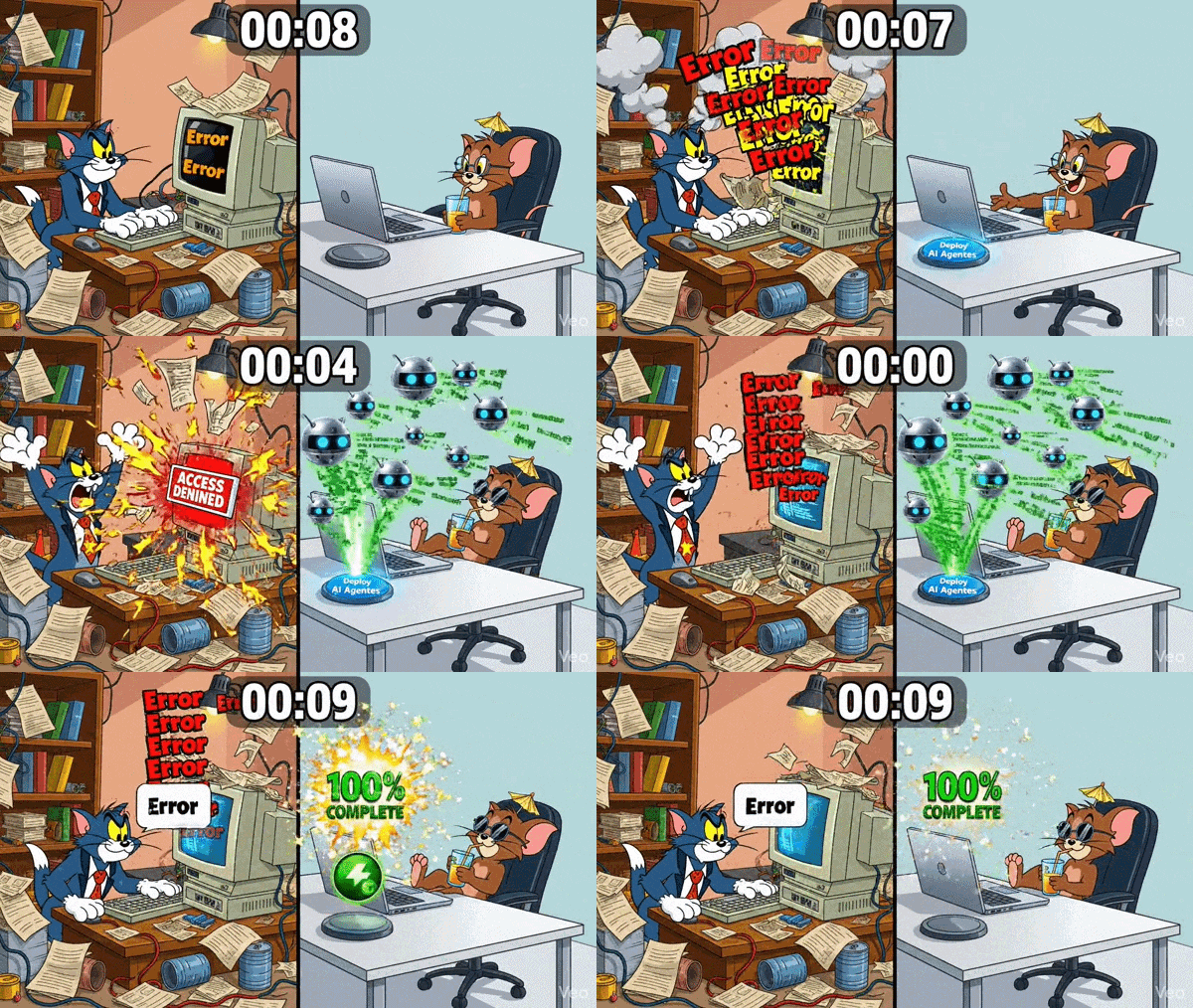
For years, engineering progress meant:
More abstraction.
Better frameworks.
Faster scaffolding.
Every generation of tools helped us write code faster. Now something fundamental is shifting. The question is no longer:
“How fast can you write code?”
The real question is:
“How clearly can you define constraints?”
Because in an AI-first world, implementation is no longer the bottleneck.
Architecture is. 🧠
The Real Fear Engineers Don’t Say Out Loud
Every week we see, some new Linkedin post on how AI is doing the automated code push. Bots are generating the pull request to production code. Massive layoffs and junior developers getting replaced.
So it raises the question where does the human stay relevant? If AI writes the code — what exactly do engineers do? I decided to take a taste of this. I started building something of my own using my VSCode and Codex.
And something became very clear:
✅ AI is excellent at execution.
❌ AI is terrible at judgment.
This changes everything. Rather I’d say, this clears the picture.
Paradigm Shift: Coding → Constraint Design
Instead of spending time scaffolding boilerplate and iterating on MVP structures, my focus started shifting automatically to something more meaningful and tactful. Before generating anything, I am defining:
Architectural guardrails
Domain invariants
Security rules
API contracts
Schema validation policies
Boundary conditions
Only after these were explicit did I allow AI to generate implementation. The result wasn’t just faster output. It was more consistent systems. I was no more creating MVP, Prototypes. This is some real Production grade artefacts.
Because the intelligence 🧠 wasn’t in the code. It was in the constraints. 📐
What Is Prompt-Driven Engineering?
One thing for sure, this is not “AI-assisted coding.”
It is structured, guardrail-enforced generation.
In PDD, the change lies in the architecture, the design principles. Here,
1️⃣ Architecture is encoded as constraints
2️⃣ Prompts become reusable blueprints
3️⃣ AI operates strictly within guardrails
4️⃣ Humans validate invariants
5️⃣ Systems evolve predictably
AI becomes the executor. But Humans are the Orchestrator. That separation is the foundation for the future of PDD based systems.
The Prompt-Driven Lifecycle
With new approaches to the development budding up, the lifecycle itself changes.
Step 1 — Problem Framing
Development begins with clarity. As with every product idea, we need to define waht problem we are going to solve. How this problem will be framed. Before code, before generation, before scaffolding — the invariants are defined. These questions must be answered and locked.
🔐 What must never break?
🔐 What boundaries cannot be crossed?
🔐 What security posture is mandatory?
🔐 What architectural layers are enforced?
Without this step, AI generation becomes structured chaos.
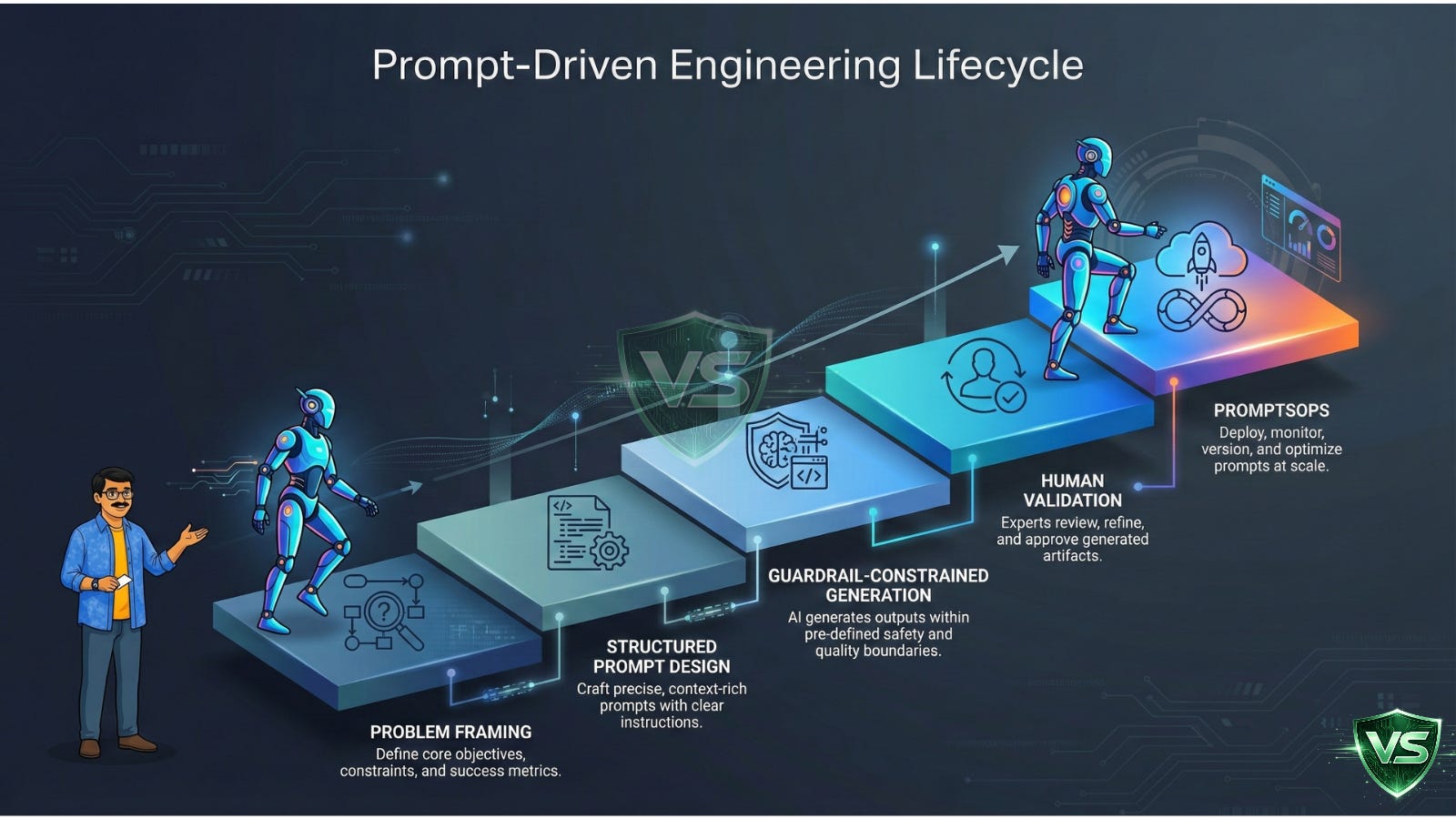
Step 2 — Structured Prompt Design
Prompts should not just be the queries and instructions coming to our mind. Prompts evolve into architectural instructions. They are not vague English requests. They encode layered separation, dependency rules, authentication enforcement, schema validation, and contract boundaries.
A vague instruction produces fragile systems. A structured prompt produces predictable ones.
Step 3 — Generation Within Guardrails
AI will generate services, APIs, modules, and tests — but only inside the defined architectural envelope. We setup some Guardrails which will act as balances and checks for the code.
Your LLM Agent is not allowed to invent structure. It implements within structure.
This is the difference between speed and scale.
Step 4 — Human Validation
The role of an Architect does not end here. The focus of review shifts from syntax correction to invariant validation. You’re no longer asking:
“Does this look clean?”
You’re asking:
“Does this violate architecture?”
That shift alone upgrades the engineering role.
Step 5 — Prompts as Artefacts (PromptsOps)
Once we have the structurally improved prompts, they are no more the random queries. Prompts are no longer disposable.
They are versioned.
They evolve.
They are documented.
They become part of the system. We need to create a way to document everything. Write decision documents, Architectural Decision Records (ADR), context documents, contracts, strategy documents. Everything is an asset now. Just like code.
The Prompt-Driven Architecture Stack
Prompt Driven Design is not abstract anymore. It has evolved in last few months. It can be visualized as a Layered system.
Layer 1 — Intent Interface
Business intent is expressed through structured interaction. Not free-form prompting — but guided intent within predefined boundaries.
Layer 2 — Guardrail Engine
This layer enforces architectural invariants, schema validation rules, authentication requirements, and dependency constraints.
It ensures generated artefacts cannot violate system design.
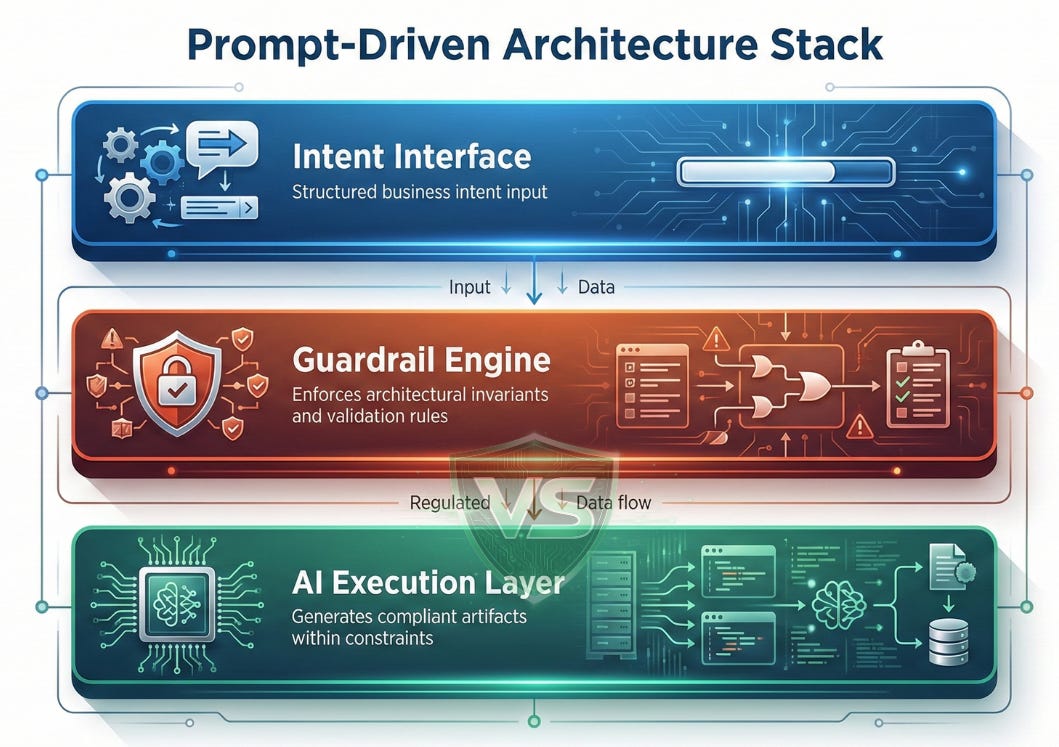
Layer 3 — AI Execution Layer
Here, AI generates implementation artefacts strictly within the allowed envelope.
Structure precedes output. Not the other way around.
The Structural Shift
We need to understand as an architect that this shift of focus is not philosophical. It is structural.
Previously, implementation decisions lived inside code. Architecture was inferred by reading repositories. Code correctness depends on the manual reviews. Scaling of the product development process required more engineers
Now, implementation decisions are encoded before generation. Boundaries are explicit. Invariants are written down. Guardrails are enforceable. Now, correctness depends on constraint validation. Scaling just depends on how clearly architectural envelopes are defined. How efficiently you can use the agent for development. The abstraction layer has moved upward from syntax to system definition.
The Human–AI Division of Labor
Think of it this way:
The Human (Architect)
Defines non-negotiable boundaries
Encodes invariants
Decides rendering strategy
Defines security posture
Designs system decomposition
The AI (High-Productivity Junior Developer)
Generates code
Fills boilerplate
Implements contracts
Writes test scaffolding
Iterates quickly
AI does not decide architecture. AI operates within it. This separation is critical. Without it, you scale chaos.
The Real Upgrade
This shift is not about removing engineers. It is about elevating them.
As guardrails become encoded and generation becomes deterministic, responsibilities move upward. Engineers spend less time on repetitive implementation and more time on:
Modeling systems
Designing constraints
Supervising generation
Encoding invariants
We’re already seeing the transition:
AI-assisted coding → Structured prompt engineering → Guardrail-enforced generation → Business-driven product evolution
The next frontier is this:
Business users define intent
Architects encode structure
AI generates compliant systems
Developers do not disappear. Their role evolves. From builders of code to designers of systems.
That is the real upgrade. 🚀
That is not replacing engineers. That is upgrading engineering.
Future : Where This Is Heading
The trajectory of this model extends beyond code generation.
It changes how systems behave, how talent evolves, and how organizations operate.
Self-Healing Systems
When constraints and validation logic are explicit, systems can begin generating corrective behavior.
AI can patch non-critical modules, regenerate failing implementations within guardrails, or revalidate schema contracts automatically.
The more deterministic the architecture, the more automatable recovery becomes.
Resilience moves from reactive debugging to proactive regeneration.
Shift in Talent Model
As implementation becomes increasingly automated, the skill premium shifts upward.
The most valuable engineers will not be the fastest typists.
They will be:
Strong system modelers
Constraint designers
Architectural governors
Documentation thinkers
Communication becomes technical leverage. Clear boundary definition becomes a core skill. Engineering becomes more about supervision and orchestration than direct construction.
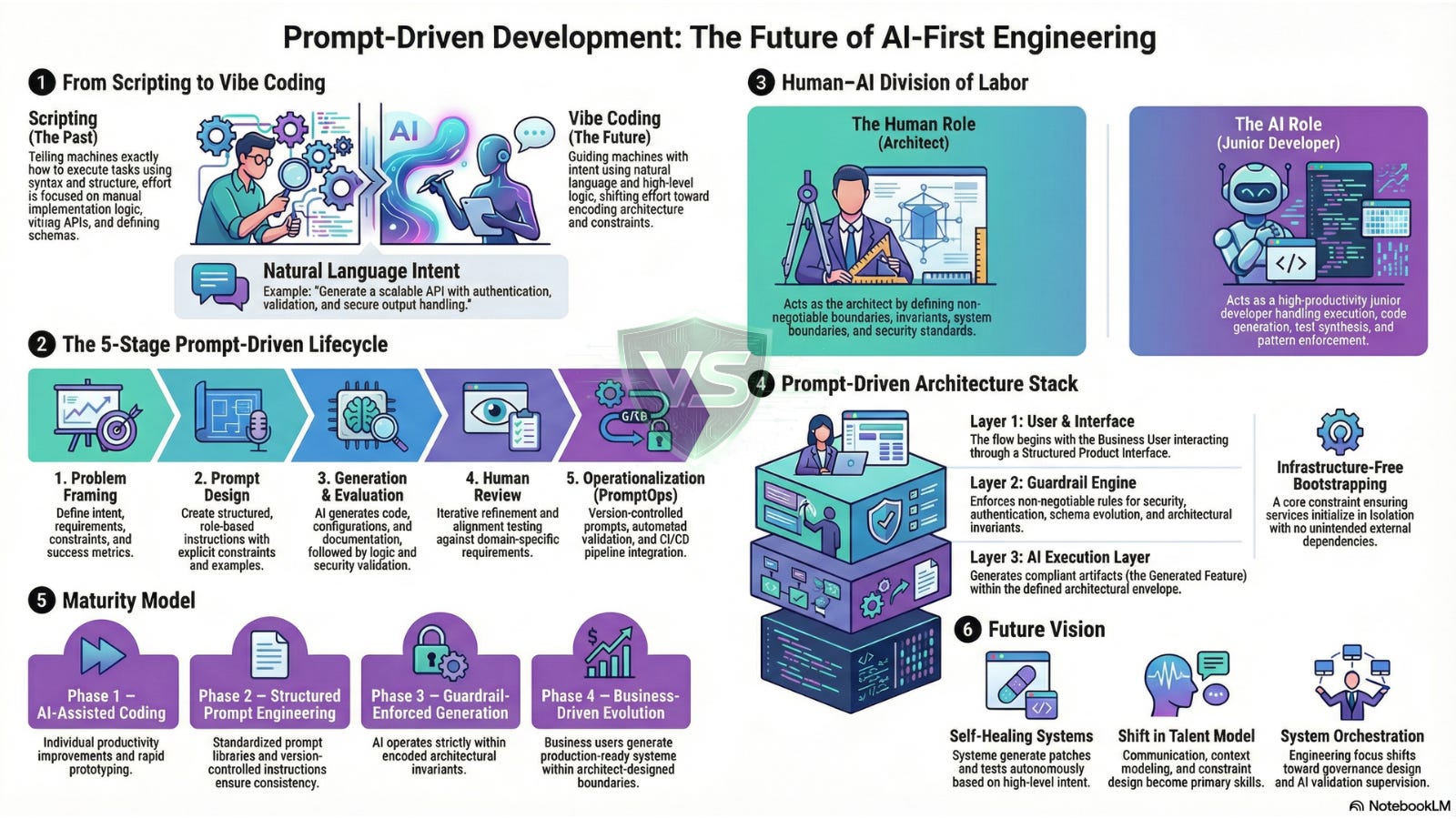
System Orchestration Over Feature Coding
Over time, development workflows shift from writing features to orchestrating systems. Architects design governance layers. Prompts evolve into domain-structured languages. AI executes consistently within those defined envelopes.
This opens the possibility that business users — operating within structured interfaces — can describe intent directly. When architectural guardrails are encoded deeply enough, compliant features can be generated without continuous developer mediation.
The developer’s role becomes:
System designer
Constraint architect
Quality governor
Evolution supervisor
Not syntax implementer.
If AI can generate code, the leverage moves up the stack.
The future engineer won’t ask:
“How do I implement this?”
They’ll tell:
“What must never break?”
And that is a very different skill.
Perfect — this needs tension, momentum, and direction.
Not hype. Not dramatic. Just controlled anticipation.
Here’s a closing section aligned with your tone:
Before We Go Further…
What you’ve just read is the foundation.
✅ The structural shift.
✅ The PDD lifecycle.
✅ The architecture stack.
✅ Separation of roles → Who will do What?
But this is still theory 📖. The real leverage appears when constraints are written down, prompts are versioned, and systems are actually generated inside guardrails.
That’s where things become concrete. And slightly uncomfortable. 🙂
Because once you see it implemented, you realize this isn’t just productivity tooling.
It’s a new operating model.
In the Next Part
We’ll go hands-on. I’ll walk through:
A real implementation example
How architectural guardrails are documented
A sample ADR structure
What a Prompt DSL actually looks like
How PromptsOps works in practice
How documentation and generation stay in sync
No abstraction. No philosophy. Just process.
I’m Curious
What would you want to see explored deeper?
The documentation structure?
The guardrail engine logic?
Prompt versioning workflow?
A real production example?
Or how this scales in teams?
Drop a comment and tell me. Your questions will shape Part 2.
If this shift interests you, subscribe now to get notified for actual implementation piece.
Part 2 will break down the actual implementation mechanics — step by step.
That’s where the system moves from idea… to execution.
And that’s where it gets interesting. 🚀
Disclosure : Visuals in this post were generated using AI tools for illustration.